22 May 2010

Senior Thesis

So far this summer I've begun to think about and work on my senior thesis, building off of the ideas I latched onto last semester. I've been writing a little about the work to flesh out my ideas, and sketching for some eventual pieces. More updates will hopefully be forthcoming, but until then here are some tidbits of what I have thus far:

Working Statement:

     In a certain sense, all art is about its maker. My art is about its maker in more than one sense.
     In my work I deal with my measure of consciousness (awareness) regarding my experiences. Sometimes the work is searching and sometimes the work is explaining, but it is always an attempt to understand the significance of my experience to myself and to my development as an individual. I have begun searching out my personal visual vocabulary, which I use in my work to revisit, reflect on, and reinterpret my life- from the events, to the feelings, to the people it contains- and what it all means to me in the moments of creation. At times, the work may coincidentally play to the universality of human experience, but typically its aim is solely the selfish, and specific. In a certain sense, all art is about its maker. My art is about its maker in every sense.


Allegory of Home series:


Charity:


all images and text © J. Timlin 2010


21 May 2010

Sketchbook, Fall 2009 & Spring 2010

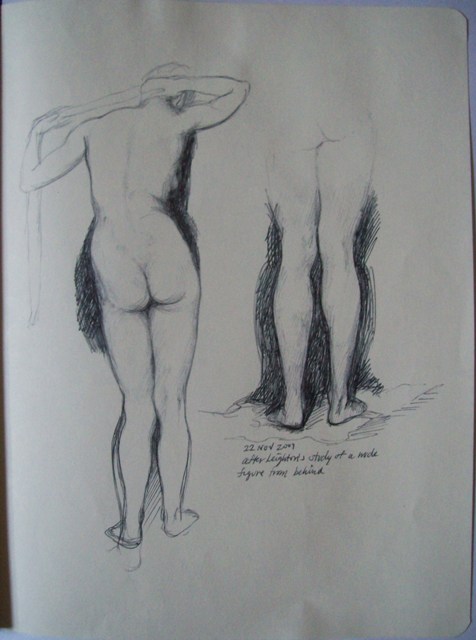
Here are some sketchbook pages from last semester, when I was at MICA, and taking the train into DC often for my internship.


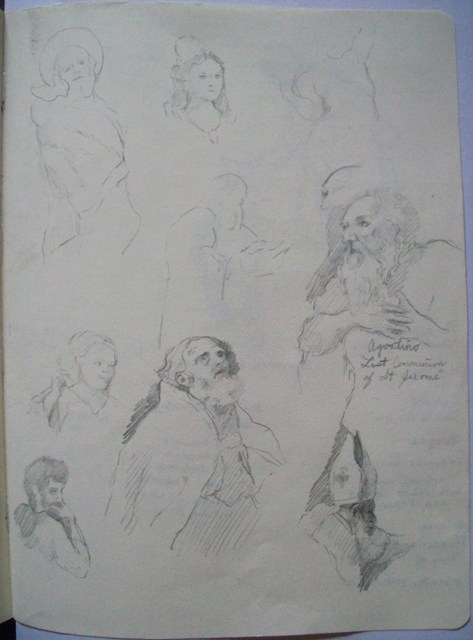
Here are some more recent pages from the same book, from trips and wandering around Italy and Florence.


all images © Jeff Timlin 2010

12 May 2010

Some studies


Ponte Rialto, Venezia by night.
Firenze from Piazzale Michelangelo.
Sketchbook page: Firenze and Venezia.

All images © J. Timlin 2010

The landscape of Florence


Some small watercolor drawings from up near San Miniato del Monte, and the Boboli Gardens.

All images © J. Timlin 2010

30 December 2009

Ciao!

     A little less than two weeks ago, my toughest, busiest semester so far ended. Shortly after, I realized that I had neglected this blog since the semester hit the ground running in August. I have quite a few drawings that I am happy with as a product of this fall, but they have been packed and stored without being photographed amidst the hectic nature of my final week. And while those drawings won't make their online debut until the summer months, I do have a number of pages in my current sketchbook that will grace this site as soon as I get the chance to scan them.
     In other (and much more exciting) news, my winter break this semester is a short one. On January 6th I'll be boarding a plane for Florence, Italy, where I'll be spending the entire spring semester studying in the Studio Art Centers International program. I'll be studying painting, High Renaissance art history, and museum studies, as well as doing any traveling possible, and a ton of museum/church hopping. My professor is requiring us to keep a sketchbook/journal of our visit, so expect excerpts from that to be posted occasionally, as well as photos of travels, and new work, and other random entries as usual.
     I'm sure to find communication with the states much more difficult while abroad. Friends and relatives please find this blog to be a resource in following my travels and experiences, as I intend to be much more diligent in its upkeep than I have been in the past 4 months. I'm really looking forward to this experience, and posting about it, so keep an eye out for new things.
     And on that note I'll close by utilizing the entirety of my Italian language knowledge... Grazie! Ciao! Spaghetti!

Jeff

29 December 2009

Victorian Aestheticism

Researching for a paper on artist Frederic Leighton introduced me to a great book:
"Art for Art's Sake: Aestheticism in Victorian Painting" by Elizabeth Prettejohn.


The book includes essays on a number of Victorian painters, some of the first to express aesthetic values, and the formative characters of the Aesthetic movement, including Frederic Lord Leighton, Albert Moore, Dante Gabriel Rossetti, and James Abbott McNeill Whistler. The essays talk about each painter in the way that his work specifically addresses aesthetic concerns, or diverts from the academic traditions of the day, and the realism of Pre-Raphaelite painting. For anyone like myself, with an interest in 19th century Aestheticism, or even 19th century art in general, this book will be an interesting and educational read.

The essay on Frederic Leighton is really interesting for explaining his background, association with the Royal Academy in London, and the way he creates a relationship between his academic working process and aesthetic ideals. The book also gave me my first real introduction to the work of Albert Moore, whose paintings utilize repetition, rhythm, and other musical ideas in visual form, which parallel the symphonic references of Whistler. The information on his use of repetition as a compositional device was unexpectedly relevant to my own taste and ways of thinking about organizing an image and controlling the gaze of the viewer.

Frederic Leighton:


Pavonia, 1858


 Icarus and Daedalus, 1869


Albert Moore:


Dreamers, 1879-82


The Quartet,1868


Apples, 1875

11 September 2009

Sargent copy


After Caspar Goodrich, by John Singer Sargent
Charcoal on paper


image © J. Timlin 2009

29 August 2009

Interesting Article

This article is from the Guernica magazine website that I stumbled upon. It discusses President Obama's choices of art to add to the White House collection thus far in his presidency. While I'm not usually one for political discussion, this article touches on some interesting points when comparing Obama's choices to those of previous White House occupants, and what the differences might say (or not say) about their differences in leadership.

Read the article here.

24 August 2009

Alex Kanevsky

A contemporary painter dealing in beautifully textured works in oil, primarily figurative but also relating to a few series. The paintings are a very interesting hybrid with similarities to Francis Bacon, Euan Uglow, and Odd Nerdrum. Bacon for their psychological weight, and the figures' interaction with the bed, chair, and bathroom; Uglow for their often fragmented and planar painting style; and Nerdrum for the repetition of figures, their cloak-like covering, and the compositional arrangement of portraits. Kanevsky seems to favor a near square format, which he handles effectively in his composition.
Images from the artist's website.


Kanevsky's paintings have a very fresh feel, which he states (in an interview) is his aim. He achieves this effect with continued reworking in which he attempts to hit his mark in one shot, and if he fails, he waits for the paint to dry and tries again. The artist has a very interesting section on his website where this process can be seen, something I've always wanted to do myself but never did. He also has a great list of links to get you searching around. It is a recommended stop for fans or fellow painters searching the web.

20 August 2009

Rosy Lamb

A painter/sculptor in Paris, using primarily plaster and oil paints. I like the effect the plaster surface has on the paintings, and she does some really interesting things with plaster frame imprints. I'm also a fan of the "unfinished" finish of some of the portraits. Although I think that relates to time constraints, it's still a good exercise in decision making and painting economy.
More of her work here.


The project she worked on called The Sleeping Author Project sounds really fun, and similar in certain ways to the portrait project I was developing. While Lamb's paintings attempted to capture the subject (a stranger) within an hour of their personal introspection or dreaming, I would want my time to be unrestrained. My painting would aim to be the physical and visual record of that time spent in the presence of the sitter (a strong personal relation or acquaintance). The process would also involve good decision making, editing, and painting economy. I anticipate my most difficult and frustrating obstacle to be the time necessary for my subjects to spend in my presence. Time is always seen as valuable and precious, something to be held onto rather than given away. Though I'd like to think my sitters would take something away from the experience on a personal level. We shall see.